

Let’s look at two proposals for Chicago pension reform. One from Paul Vallas, ex-candidate for mayor of Chicago (among many other roles), and one from a trio of high schoolers.
This is not really unfair to post head-to-head — the high schoolers won a modeling competition with their proposal. But let’s look at Vallas’s proposal first.
Paul Vallas: Let’s Fix Chicago Pension Asset Management
8 June 2026, Chicago Contrarian, Paul Vallas: Chicago’s Pathway to Real Pension Reform
There’s a clear pathway to addressing the state and city pension crisis that will neither bust the budget nor require major tax increases. Pensions will only be fixed if the management of the pension systems and its investment decisions are completely insulated from politics
Ooooooh, an asset-side fix.
Where have I heard that one before.
To be sure, they have a crappy return. (More on that in a bit).
But a huge part of that is they’re so underfunded, they have to keep most of their holdings in cash JUST TO PAY BENEFITS.
But let me let Vallas lay out his argument before I start cutting it down.
The Equable Institute reported Illinois retirement shortfalls rank Illinois among the states with the lowest pension funded ratios (the percentage of promised benefits that are actually covered by assets). In July 2025, its funded ratio was 50.6 percent, ranking it as the second worst in the nation, just behind New Jersey. This is significantly below the 60 percent threshold that many experts consider to be deeply troubled.
OH NOOOOO, Not you, Vallas!
Just picking two items (on 80% fundedness, not 60%):
May 2020: STUMP Classics: What’s So Bad About 80% Fundedness?
Sep 2020: The End of an Era: Where are the 80% funding myths of yesteryear?
I may need to bring back my funded ratio posts, but I am not going to recap the problem with any hard-and-fast funded ratio benchmark other than 100%.
Back to Vallas (I’ve skipped over some paragraphs):
Expanding benefits without dedicated funding is a recurring theme in Illinois financial history, most demonstrated by its public pension crisis as well as the states chronically underfunded Medicaid expansions. Because the state’s constitution legally protects promised public retirement benefits, expanding these benefits without setting aside cash has left the state with a massive structural debt.
The most recent example was Governor JB Pritzker’s cowardly signing on to the flawed changes to the Tier 2 system to the benefit of Chicago Police and Fire pensioners will add $11 billion to Chicago’s $36 billion pension debt. It will drop pension funding levels of both Police and Fire pensions from 25 percent to 18 percent. The “Tier 2” pension problem in Illinois centered on concerns that benefits for public employees hired since 2011 will eventually fall below Social Security levels.
I completely agree with Vallas here. Here are a few of my posts on the “pension sweeteners” for Tier 2:
25 Sept 2025: Chicago Pensions: The $11 Billion Sweetener, POBs, and the Road to Insolvency
4 Aug 2025 Podcast: Chicago Pension Artificial Sweeteners
25 July 2025 More on Chicago Pension Finance: Those Pension Sweeteners Sure are Sour
Chicago Poor Investment Returns
Back to Vallas — I’m excerpting this whole subsection of his piece, because I want to address this whole thing: [I have bolded key parts]
A history of poor investment returns
Illinois and Chicago have struggled with a combination of chronically low funding ratios and persistent underperformance in investment returns compared to national averages, to go along with the delayed or inadequate contributions by state and city governments. Despite periodic market upturns, Illinois state pensions have historically underperformed the preliminary national average by over a full percentage point. Illinois Policy estimates sub-par investment returns have contributed to the massive Illinois pension debt — accounting for roughly 11 percent of the shortfall.
Employees do not own or control their own retirement funds under a pension system, nor do they have their own accounts. Instead, state officials and politicians control the pool of funds, allowing them to use workers’ retirement dollars as a political slush fund. This of course involves the historic practice of “kicking the can down the road,” including pension holidays to free up money for other needs. It also includes the multiple pension funds politicizing pension fund investors.
Public pension funds in general — and the city’s pension funds even more so — underperformed basic investment approaches frequently used by individual investors in their 401(k) plans. The Bloomberg proxy for a conventional portfolio made up 60 percent of indexed U.S. stocks and 40 percent indexed bonds returned 8.48 percent annually over those 10 years. And the S&P’s 500 index returned a whopping 13.1 percent annually in that time frame.
First, that bolded item is true for Chicago pensions, though not necessarily the Illinois funds.
Let me show you the results of some key funds. I’ll do the Illinois Teachers fund: [all data from the Public Plans Database]
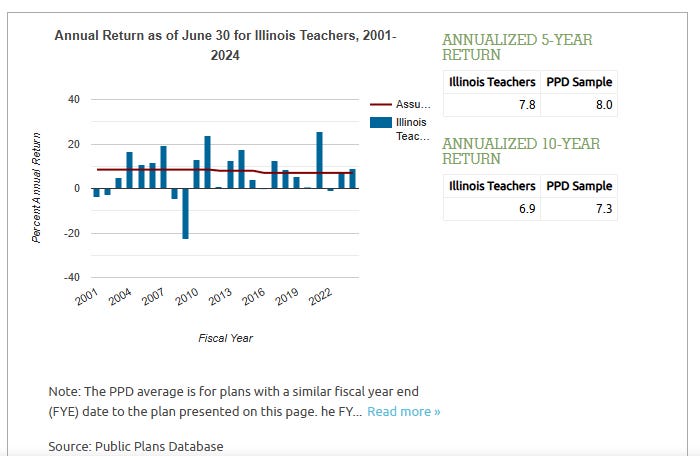
The 5-year return isn’t as important as the 10-year return: 6.9% vs 7.3% — a 0.4% difference. (The caveat — it’s difficult to compare fund performance, as some are reporting net returns, net of investment fees… and some are not. THERE ARE NO REPORTING STANDARDS for performance here - one thing I agree with Ted Siedle about.)
Here’s the Illinois Municipal fund: (the one Illinois plan that is well-funded)
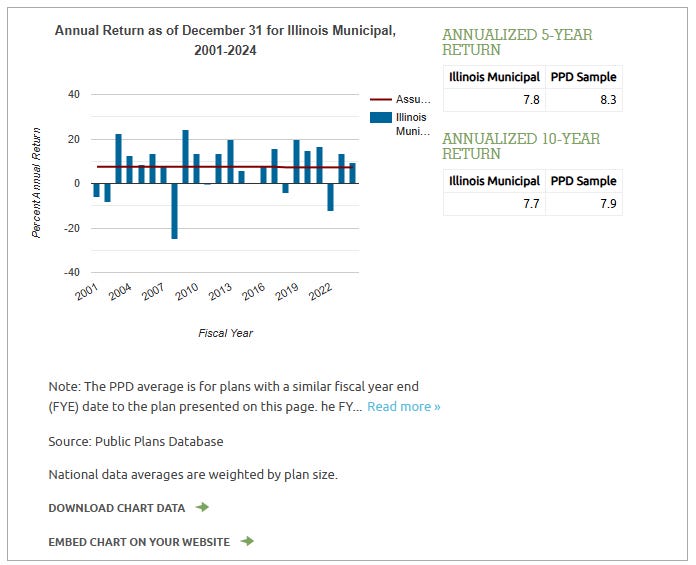
You’ll notice the sample this one is compared against has different averages — they compare teachers funds against teachers funds, and general public funds against general public funds, etc. Anyway, IMRF is doing okay.
But here is the Chicago Municipal fund:
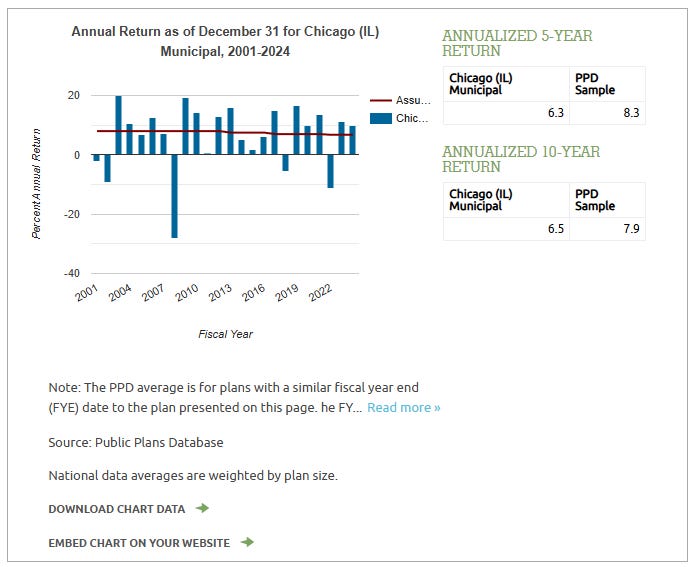
Holy crap! Why so bad?
This is why:

10% of the fund is sitting in cash.
Because Chicago Municipal is only 26% funded:
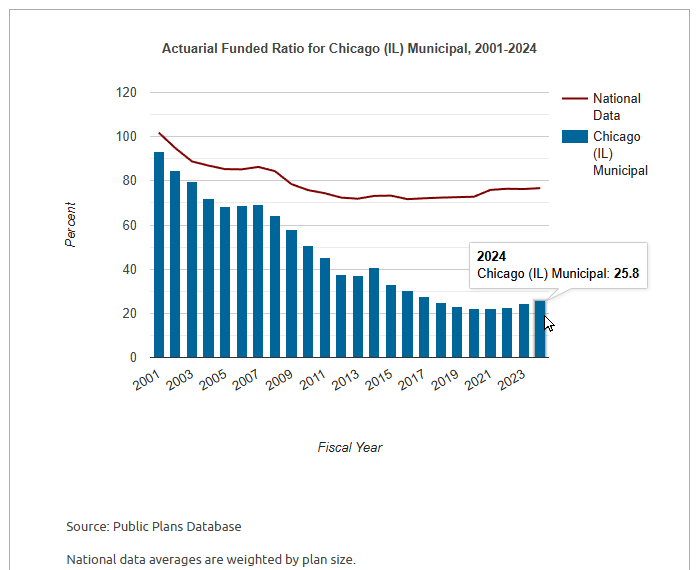
They need to have a bunch of the fund in cash to pay the current benefits.
This addresses why 401(k)s themselves can perform better than underfunded pension plans. 401(k)s don’t promise anything. You can pursue pure performance, if you wish. You will be forced, as an individual, to cash out 401(k)s in retirement, so that the government can tax you, but that has nothing to do with promised retirement income.
Public pensions have to pay promised benefits, so asset allocations have to get adjusted to try to meet those promises.
That’s the theory, at any rate.
I do have some “chasing yield” theories for public pensions in general I will post about later, but Chicago pensions are particularly strained for keeping up with cash flow.
Vallas does have ideas to support other than asset management-related ones, so let me extract the list:
1. Expand the state pension buyout program
This can reduce the liability by a small percentage, and pulls more cash out of the assets… this may be a wash. It can actually make things worse, depending on how it’s executed.
2. Use surplus revenues to pay down pension debt
WHAT SURPLUS REVENUES?
(Also, we see what sort of crap politicians like Brandon Johnson get up to)
3. Protecting Tier 2
Good luck with that. There’s always buying votes by increasing benefits.
4. Redirect expiring bond payments
This is a good idea. Maybe the next Chicago mayor can follow it. But again, Chicago has been strained to make some of these payments… it is questionable whether this can be followed.
5. Fixed-length amortization
Excellent idea. This is a problem with many underfunded pension systems - they have rolling amortization of their unfunded liabilities, which means the pension debt is never retired (cough, cough).
6. Reform pension fund investment practices
I actually agree with Vallas on the need to try to pry the politics out of the public pensions… but it may be impossible. It’s the nature of the beast.
Let me quote him: [bolding added]
To strengthen returns and depoliticize investments, the state and the city should consolidate its funds under a single or separate (state and city) independent “Public Employee Retirement Investment Boards”, free from ESG requirements and insulated from local political influence. This is absolutely essential for ensuring investments are made strictly on merit and fiduciary duty, rather than political agendas.
Additional measures might include the states offering workers the option of a 401(k)-style plan that provides portability, predictability and reduced risk for taxpayers. Lawmakers should also consider constitutional reform that would allow Illinois to make modest benefit adjustments to not-yet-accrued pension benefits similar to what states like Michigan, Arizona, Pennsylvania and Utah have done to improve the health of their pension systems.
It’s not just ESG boards that are an issue, but any divestment call or explicit “invest in the community” calls. This is not specific to any party — it’s that politicians are not fiduciaries of the pension funds.
Governors aren’t, the legislators aren’t, the mayor isn’t… and on and on. I have years of posts on divestment/investment activism for public pensions, and it’s not all under the umbrella of “ESG”. It started waaaaaay back in the boycotts of South Africa. Remember that?
Then it was divestment from tobacco products… then guns…. then there was an ESG framework… then BDS with Israel… and then private prisons…. and it’s never-ending.
One administration says “ESG or else!” and another administration says “If you have ESG, you aren’t following fiduciary duty!” You’re going to get stuck either way.
If they can de-politicize the investments in Chicago and Illinois, it will help, but not really by much. Any (and all) asset-side proposals tend to ignore the big problem are the pension promises themselves, which is why I bolded the constitutional reform part.
That’s the only thing that can really help — they need to be able to reduce the liabilities, current liabilities, for Chicago.
To get even the most minor of reductions requires amending the Illinois state constitution.b
Best wishes.
High School Modelers: Contribute More
What about the high schoolers?
The Disciples of L’Hôpital (it looks wrong on the website, but I assume the website folks didn’t know how to display it properly), a trio of students from Stevenson High School in Lincolnshire, Illinois, won this year’s Modeling the Future Challenge with a paper titled:
Back on Track: Modeling the Recovery of Chicago’s Underfunded Pension System
Executive Summary: [I added some bolding]
The Chicago Municipal Employees’ Annuity and Benefit Fund (MEABF) holds $5.06 billion in assets but $19.92 billion in obligations, resulting in a funded ratio of only 25.4% [1, 2]. Over 25,000 retirees depend on this fund to live, and nearly 39,000 active city employees face uncertain retirement security in the future. In the case of insolvency, the city would be required to make up the difference of about $1.1 billion for benefits out of its general revenues each year, which would amount to about $400 for each citizen of Chicago annually, despite high taxes. In this paper, we investigate what strategies can allow the fund to recover to the state-mandated 90% funded target by 2055.
We built three models to test two different strategies: an investment modification strategy and an insurance based annuity strategy. Our liability projection model uses exponential regression adjusted for the new Tier 2 benefits. Our Monte Carlo asset simulation generates results for five different investment strategies, using correlated returns, compliance, and cash flow dynamics. Our annuity valuation model estimates the cost to transfer the fund’s obligations to a private insurer, using insurance pricing benchmarks [11]. The purchase of all retirees would amount to $19.1 billion, or almost four times the present value, but a selective buyout, covering only the oldest 25%, amounts to $3.1 billion, saving $300 million annually in benefit payments, giving an alternative fallback.
Our analysis draws on four key datasets: 24 years of Chicago pension fund data from the Public Plans Database(PPD), S&P 500 historical returns from Macrotrends, Moody’s Aaa Corporate Bond Yields from the Federal Reserve Economic Database (FRED), and annuity and retirement payout benchmarks from ImmediateAnnuities.com.
What stood out most in our analysis is that contribution compliance, meaning whether the city actually pays what actuaries say they need to, matters far more than investment strategy. We found that moving compliance from 70% to 100% shifts the median 2055 funded ratio up by 79 percentage points, which is nearly five times the effect of switching between the best and worst investment portfolios. If the city sustains full compliance, every investment strategy we tested achieves a median funded ratio above 90%. Without it, no strategy exceeds a 47% chance of reaching even 80%. Another concerning finding is that the fund has no safeguard against compound stress. Our worst-case scenario, where a market crash, stagnant payroll, and contribution retreat all hit at once, leads to insolvency in 99.4% of simulations. Each of these shocks alone is survivable, but together they completely devastate the fund.
Based on our model results, we recommend three actions: (1) establish full contribution compliance through dedicated revenue and a binding ordinance (behavior change); (2) adopt a Growth investment while considering options to de-risk the investments as the funded ratio gets closer to 90% (behavior change); (3) commission analysis of pending Tier 2 benefit legislation (behavior change); An alternative recommendation we explored was to evaluate the feasibility of a partial annuity buyout for the oldest retirees (insurance). We also explain why we could not find any viable modifying outcomes strategies, as the pension benefit structure is constitutionally protected in Illinois [8]. Our recommendations are directed to the Chicago City Council, the MEABF Board of Trustees, and the Illinois Comptroller.
They did incorporate the pension sweetener bump up, and to explain: the “behavior change” and “insurance” and “modifying outcomes” are three methods/categories the students are given as a framework in solving their problems.
They are allowed to choose problems to work on — other winning papers dealt with self-driving vehicles and traffic collisions, teacher turnover in Tennessee, desalinization plants, the economics of GLP-1 drugs — but they’re given actuarial frameworks by which to approach the problems.
Needing to amend the constitution
I want to pull out what they wrote in the paper about why they couldn’t “modify outcomes”:
From problem statement [page 5]
Third, modifying outcomes: we did not identify a viable modifying outcomes strategy, as the pension benefit structure is constitutionally protected and cannot be changed for current members [8]. For example, reducing COLAs from 3% to 1.5% would significantly reduce growth, but these types of structural changes would require a constitutional amendment, which is beyond the scope and politically infeasible.
Risk mitigation strategies [page 22]
In this scenario, modifying outcomes strategies do not hold much promise, and we do not spend time developing recommendations around them. This is because most modifying outcomes approaches would require massive structural reforms within the pension system, such as changing the payment structure or reducing COLAs (cost-of-living adjustments). Illinois’ constitution (Article XIII, Section 5) prohibits reducing benefits for current employees and retirees [8], and a constitutional amendment is both beyond the scope of fund-level recommendations and politically infeasible in the foreseeable future. The impact of a COLA reduction from 3% to 1.5%, a Tier 1 cut, would decrease growth of liabilities by an estimated 0.8% per year and increase the 2055 median by 15 to 20 percentage points; however, the Illinois Supreme Court struck this down in 2015. We therefore focus our recommendations on the behavior change and insurance categories where actionable solutions exist.
You know what? Good for them for not wasting their time on what cannot be politically achieved.
I am not going to address all of their proposals (making the Tier 2 sweeteners be valued before passing… well, they didn’t really do it last time, why should they do it this time? Annuity partial buyout is a risk management move, and unlikely to happen, and I don’t want to get into why).
I want to look specifically at the contribution proposal:
Recommendation 1 (Behavior Change, Ensuring Compliance): Standardizing 100% contribution compliance is the action with the greatest impact on the fund. Our models show that this action alone can increase the median funded ratio from 68% to 108% and raise the chance of reaching an 80% funded ratio from 40% to 72%. This action should be implemented within 1 to 2 years through a binding ordinance and dedicated revenue streams. Since this action directly addresses the fund’s most significant risk, no other suggestion comes close to its potential impact
This falls apart the first time Chicago runs into a “crisis”. Aka, Brandon Johnson as mayor. They do mention mechanisms from the Illinois legislature onto the city of Chicago, which can happen, but the legislature can always change its mind.
You cannot bind the Illinois legislature outside of the constitution.
OH WAIT.
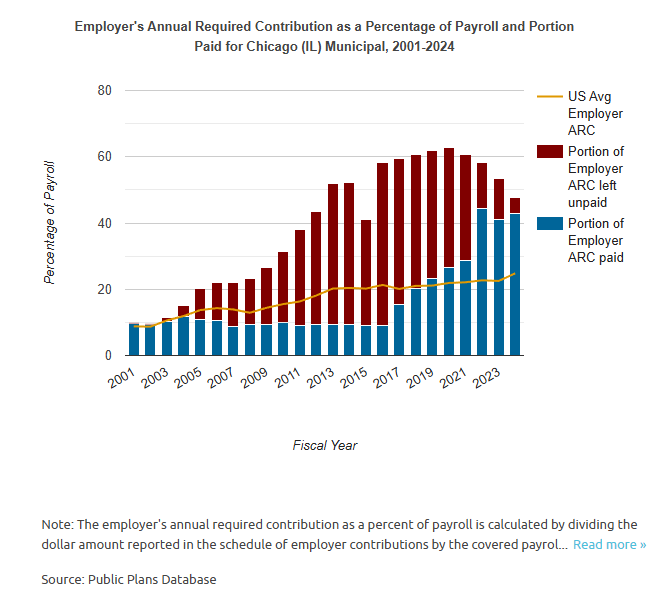
The legislature has tried forcing Chicago to make 100% contributions — this is what has happened.
Chicago Municipal contribution history:
This year, Brandon Johnson and his crew tried to sneak in some secret borrowing to cover some of the pension contributions and other spending:
13 Mar 2026: Chicago Downgrade Watch: Reactions and Bond Pull
2 Mar 2026: Chicago Watch: Bond Downgrades and Secret Borrowing
Chicago has yet to be able to afford to make full pension contributions on their own cash flows. They have to borrow money if they are to make full contributions.
This is reality.
What the students wrote: [bolding added]
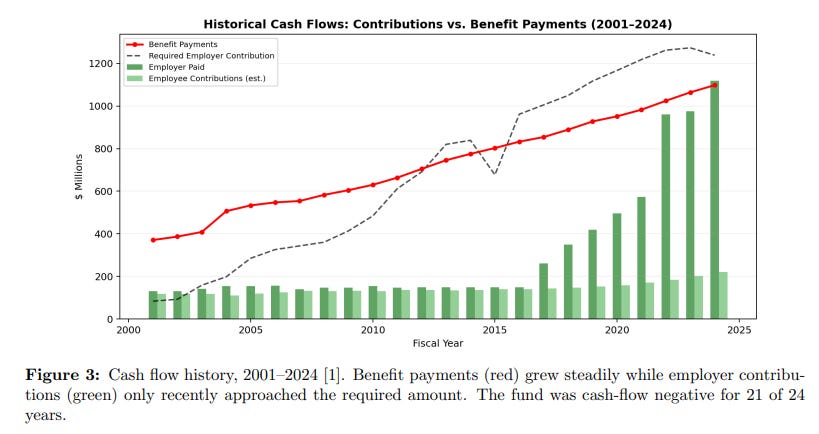
4.2 Risk 1: Employer Contribution Shortfall (Critical)
This is by far the most important issue facing the Chicago pension funds. When the city does not match its required payments, the shortcoming is not temporary. It turns into additional unfunded liability that accrues interest, and continually underfunding just makes the issues worse as years go on. This creates a compounding effect that accelerates the crisis over time. In our stress tests, the median funded ratio swings by 79 percentage points depending on compliance alone, from 29% at 70% compliance to 108% at full compliance.
To put the severity of this risk in perspective: at 70% compliance, the fund would struggle to reach 29% funded by 2055, not much better than the current situation of the fund. If that were to happen, the unfunded liability would balloon to approximately $35 billion, representing an additional $20 billion in money the taxpayer need to supply beyond the already large amount. If this were to occur, annual benefit payments would soon exceed the fund’s total assets, forcing the city to pay retirees directly from the general budget, taking away from many key social services and angering the general public.
Figure 12 clearly shows the historical damage this issue can have. Both the red and green lines were simulated under the same market conditions starting in 2001 to the present, including the same 2008 crash and the 2022 market crash. The only difference between these lines was whether the city paid what it owed or not. With full compliance, the fund would be 108% funded today instead of 25%. That 82 percentage point gap is worth over $16 billion in lost compounded contributions and investment returns [1].
The likelihood of this occurring is moderate to high. Chicago’s average compliance over the last 24 years is just 45%[1]. It is true, however, that following the 2016 enforcement mechanism (state fund intercepts) has been effective, but this solution is only applicable to statutory minimums and is reliant on continued legislative support. With pension consuming 40% of the corporate fund [12], the pressure to redirect money toward other city services is intense. Ultimately, compliance is a variable (driven by political decisions), and no actuarial model can predict it reliably over 30 years.
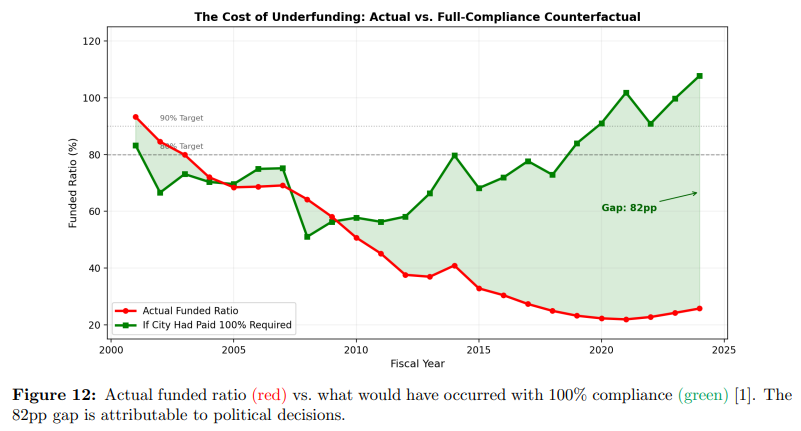
This is an excellent paper — it won, after all. The purpose of the competition was for the students to try out different modeling techniques and problem-solving, not necessarily to deal with intractable political problems.
I like what they did with Figure 12: a counterfactual showing how well-funded Chicago pensions could have been (green line), instead of what they actually did (red line).
IF ONLY Chicago had properly funded its pensions, it would not be in its current mess.
However, it is in its current mess.
And it really can’t afford the contributions to get out of it, if one is being serious. Politically, it is about as feasible to amend the Illinois state constitution to change COLAs on current pensions as to afford Chicago pension contributions.
The high school team did address the difficulty in increasing contributions, and the strain on Chicago budgets:
Of course, this solution is not very cheap. Reaching full compliance requires roughly $1.24 billion in 2025, growing to $2.60 billion by 2055. Going from 85% to 100% adds about $186 million from the city per year. Chicago already carries a heavy tax burden, and further increasing taxes could result in multiple harmful results including a population exodus and a decline in businesses. But each dollar not contributed today compounds into roughly $3 to 4 of additional unfunded liability over 30 years, highlighting the need to act now rather than in the future. And the S&P BBB downgrade [4] already reflects the market’s assessment that the current trajectory is unsustainable. Furthermore we know solutions of this kind can work: compliance jumped from 15.6% to 90.3% in eight years [1].
The compliance in Chicago jumped in eight years, because MEABF was going to run out of cash. They were staring disaster in the face, which forced them to act.
That said, the high schoolers were in a math modeling competition (with an actuarial bent), not a political science competition, per se.
So well done, y’all! Excellent paper!
And Chicago… if you can’t afford those contributions, perhaps you can’t afford the pensions… maybe consider asking Illinois to amend the state constitution, in order to dig out of your problem, mmm?