

9 May 2026, FT: Iowa pension chief resigns amid concerns about performance figures
The $47bn Iowa public pension fund has been plunged into a governance crisis, with its chief executive resigning, its chief benefits officer terminated and a former risk officer claiming top officials misled the investment board.
Greg Samorajski, chief executive of the Iowa Public Employees’ Retirement System, resigned effective May 1, while Steven Herbert, its chief benefits officer, was fired effective on Thursday after both had been placed on administrative leave during investigations into unspecified misconduct allegations.
A former risk officer, Rich Wiggins, alleged in a lawsuit that Samorajski and chief investment officer Sriram Lakshminarayanan used misleading benchmarks and risk measures to make the fund appear to be performing better than it was.
Samorajski, Herbert and Lakshminarayanan did not respond to requests for comment.
I’m not going to quote further from FT (paywall), but let me give you other sources:
8 May 2026, ai-CIO: Iowa Pension Chief Executive Resigns Following Misconduct Probes
Greg Samorajksi, CEO of the Iowa Public Employees’ Retirement System, resigned from his position about one month after being placed on leave while being investigated for allegations of misconduct. Samorajski notified Governor Kim Reynolds’ office of his resignation on May 1, a spokesperson for IPERS said.
Additionally, Steven Herbert, who was chief benefits officer for IPERS and who had also been placed on leave following a separate misconduct investigation, was terminated from his position on May 7, the spokesperson said.
….
The specific misconduct allegations against Samorajski and Herbert were not disclosed.
This story starts a bit back, as a lawsuit set this off (and the lawsuit continues).
Looking into the lawsuit — started in July 2025
21 July 2025, Des Moines Register: Former risk officer sues IPERS after firing, says officials are misleading about returns
A new lawsuit states that Iowa’s $45 billion employee retirement fund is being mismanaged by officials painting a misleadingly rosy view of their performance.
Rich Wiggins, who worked for the Iowa Public Employees’ Retirement System as its investment risk officer in 2022 and 2023, is suing the state for wrongful termination, saying he was fired for objecting to questionable investment strategies and reporting policies.
Wiggins’ complaint describes several areas where, he said, IPERS at minimum does not follow best practices and at worst is intentionally deceiving pensioners and state leaders.
Let’s check what the Public Pension Database says, because I have a thought (looking at those specific years).
PPD page for IPERS, investment returns
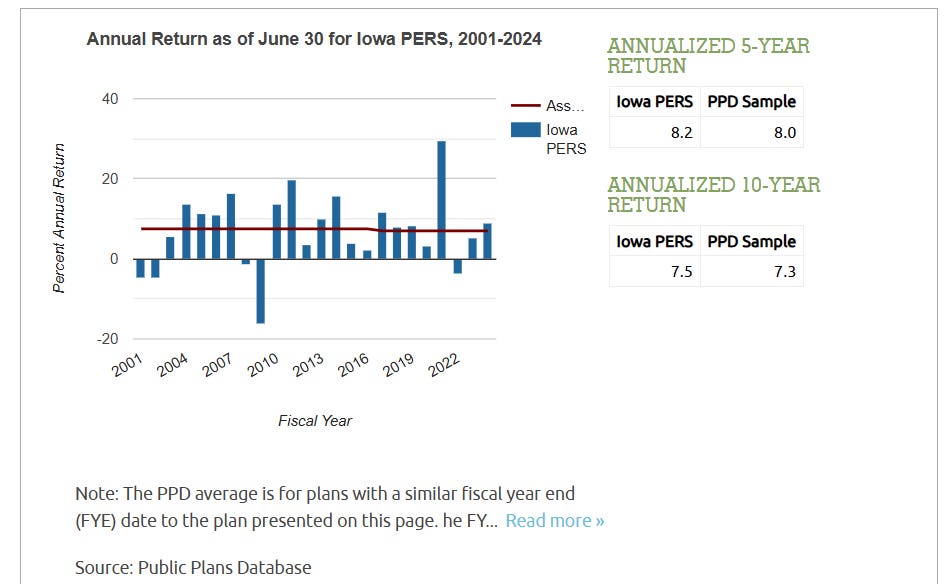
So, according to the official audited financials (which is where the PPD gets its numbers), the reported investment returns are averaging about the same as similar plans.
BUT THERE’S A BIG HOWEVER (and I will have more to say about that below.)
Via other sites (and I will link them), I obtained the amended petition by Rich Wiggins in the lawsuit, filed 30 Jan 2026.
Amended Petition

Obviously, this is a lawsuit by Rich Wiggins in a case where he had been terminated, and he is claiming that he was wrongfully terminated in retaliation for trying to point out various actions on the part of some of the people who have been given the boot (and some who have yet to be given the boot.)
So, it’s all allegations at this point.
But if it goes to trial — it’s a civil action, so Wiggins could settle out of court — we may find out more of the details beyond the petition. Because some details may apply to more public pensions beyond IPERS. Rich Wiggins may be aware of that.
Sources for amended complaint:
6 Apr 2026, Timothy Tucker, Restoring Democracy’s Promise [on substack]:

Website with download: Restoring Democracy’s Promise page on The Lawsuit Iowa
Still Hasn’t Answered in Public, with timeline
Ghosts of Public Pension Scandals Past: PSERS
In the amended complaint on January 2026, the following is given:
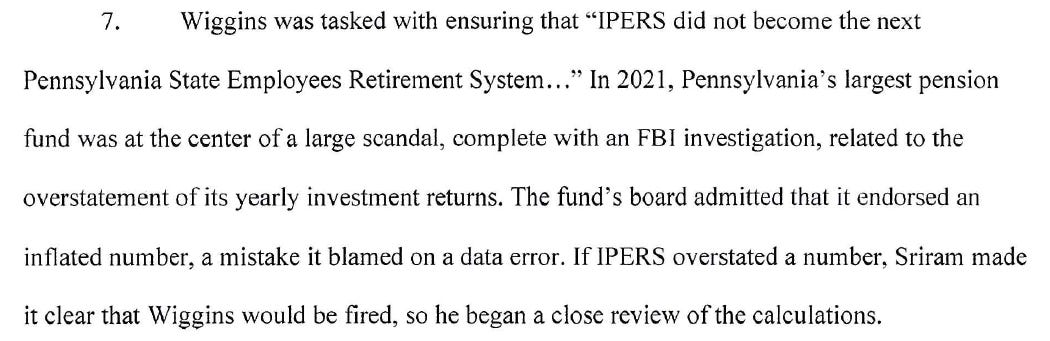
Ah, PSERS. I had “fun” with that one.
There are multiple parts to this: mismeasurement of returns (and I would argue due to a cliff incentive, which is not a great idea), the hiding of high fees from alternative assets, and very high allocations to alternative assets.
Let me take this in chronological order.
June 2017: Pennsylvania Pension Trends: Assets
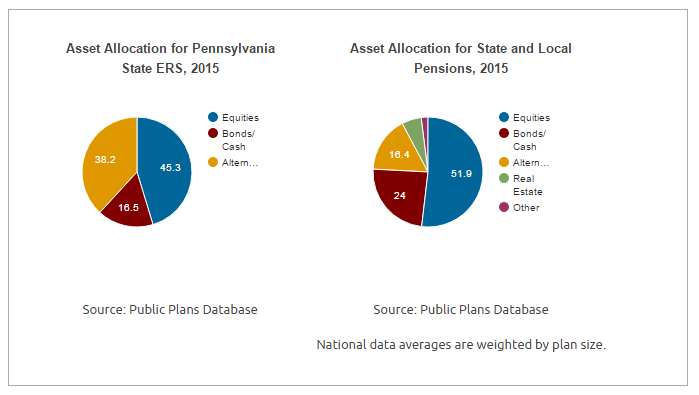
NOTE: The superhigh allocation to alternative assets.
It turned out that PSERS was underperforming similar-sized public pension funds, and at the time, they blamed the high investment fees they were paying:
Pennsylvania’s Auditor General has lambasted the state’s Public School Employees’ Retirement System (PSERS) for paying fees that were “woefully unfair to taxpayers and PSERS members.”
The findings come from Auditor General Eugene DePasquale’s recently released 151-page audit report of PSERS, which covers July 1, 2013, to March 31, 2017.
“One of my most significant concerns from this audit is that PSERS doesn’t seem to think spending more than $416 million on investment management fees in 2016 is a big deal,” he said. “It is mind-numbing that they want a pat on the back for reducing the fees from $441 million in 2015.
In 2000, PSERS was overfunded by 24% and remained above 100% funded until 2003, according to the auditor general’s office. As of June 30, 2016, PSERS was down to 57.3% funded with an unfunded liability of $43 billion, and invested assets of $49.2 billion.
“There should be a never-ending focus on driving the fees paid by PSERS to the absolute lowest level possible,” DePasquale said, noting, “Every investment fee dollar saved remains in the pension fund for the benefit of the retirees and the accrued savings of the taxpayers.”
May 2018: Alternative Assets and Pension Performance: A Dive into Data
In this later post, PSERS was continuing its pursuit of yield in higher asset risk, in trying to make up for its abysmal funded ratio (as opposed to putting in higher contributions and reducing portfolio risk… because dammit, that’s boring and expensive!):
Pennsylvania’s $30 billion state pension fund — the State Employees’ Retirement System (SERS) — made so much money in the stock-market boom over the last few years that it will cut taxpayers’ “employer contribution rate” for the first time since 2010, while still boosting total assets.
Does that mean it’s time for changes in strategy?
…..
SERS’ investment assets rose to 61 percent of the state’s long-term pension liabilities in 2017, from 56 percent the year before. That will help SERS go ahead with a projected cut in state pension contributions, to a 32.9-cent surcharge from taxpayers, on top of every dollar paid to a group of state workers in fiscal 2018-19, down from 33.2 percent this year, without weakening the plan.Cutting in here for a second: 61 percent funded is awful. Do we all understand that? Okay, moving on:
But SERS isn’t waiting for the stock market to repeat that extra-strong performance. Instead, it’s pulling back on stocks — and bonds — to invest more in real estate and “private equity” corporate buyout funds like the ones managed by Sixers owners Josh Harris (Apollo Global) and Steve Schwarzman (Blackstone). This reverses a recent trend toward SERS buying more cheap stock and bond-indexed investments.
The switch angered State Treasurer Joseph Torsella, who responded Friday with a statement condemning SERS’ recent investment focus: “I am deeply troubled by SERS’ new asset allocation strategy that will result in an extraordinary 38 percent of total fund assets in illiquid, high-risk, and exorbitantly high-fee ‘alternative’ investments,” he said. “This would be a significant increase from the already high level of 30 percent currently, and would be higher than 85 percent of US pension funds. For a system that has made significant progress recently, this decision will be a real step back.”
May 2021: Which Public Pension Funds Have the Highest Holdings of Alternative Assets? 2021 Edition
Prelude: Pennsylvania Pension in Trouble Over Chasing Yield
Frankly, if your pension fund makes the pages of the New York Times, it’s not because things are going well.
NYT: F.B.I. Asking Questions After a Pension Fund Aimed High and Fell Short
The search for high returns takes many pension funds far and wide, but the Pennsylvania teachers’ fund went farther than most. It invested in trailer park chains, pistachio farms, pay phone systems for prison inmates — and, in a particularly bizarre twist, loans to Kurds trying to carve out their own homeland in northern Iraq.
Now the F.B.I. is on the case, investigating investment practices at the Pennsylvania Public School Employees’ Retirement System, and new questions are emerging about how the fund’s staff and consultants calculated returns.
…..
The error in calculating returns was a tiny one, just four one-hundredths of a percentage point. But it was enough — just barely — to push the fund’s performance over a critical threshold of 6.36 percent that, by law, determines whether certain teachers have to pay more into the fund. The close call raised questions about whether someone had manipulated the numbers and the error wasn’t really an error at all.
…..
“If you can’t change the benefits, and you can’t change the contributions, the only lever left for these people to pull is investment policy — that’s it,” said Kurt Winkelmann, a senior fellow for pension policy design at the University of Minnesota’s Heller-Hurwicz Economics Institute. “And that exposes younger beneficiaries and taxpayers to a lot of risk.”
There are many big issues involved in public pension funds getting involved in alternative assets as part of their investment strategy, and you know if you’ve done something where the FBI is taking a look…… well. That’s worse than an actuarial malpractice lawsuit. One is only money. Federal fraud charges are more deadly. To be sure, there may be nothing really untoward, but I will get to that at the end of this post.
I did a few videos:
June 2021: PSERS Update: What if it’s just sloppy processes?
There was a federal investigation, yadda yadda, but it took until January 2024 for the consulting company involved to be sanctioned.
Washington D.C., Jan. 25, 2024 —
The Securities and Exchange Commission today announced settled charges against Aon Investments USA Inc., a Chicago-based registered investment adviser, and the firm’s former partner, Claire P. Shaughnessy, for misleading their client, the Pennsylvania Public School Employees’ Retirement System (PSERS), about the reason for a discrepancy between two different calculations by Aon of PSERS’s investment returns for the same period.
The SEC’s orders find that Aon was responsible for calculating PSERS’s investment returns for “risk share,” a provision under Pennsylvania law that requires public school employees to contribute more to their pensions if the retirement fund does not meet certain investment return rates. If PSERS’s investment return rate for the nine-year period ending June 30, 2020 was lower than 6.36 percent, it would trigger risk share, requiring an increase in public-school employees’ contributions.
According to the SEC’s orders, in June 2020, Aon provided PSERS its quarterly returns for the purpose of estimating PSERS’s investment return rate. The orders find that some of the quarterly returns Aon provided to PSERS in 2020 did not match the historical returns that Aon previously provided PSERS for the same periods. According to the SEC’s orders, PSERS repeatedly questioned Aon’s calculations of the investment returns and asked Aon to investigate a discrepancy between the returns. The SEC finds that, in response to these inquiries, Aon and Shaughnessy, who led the PSERS engagement, failed to adequately investigate that discrepancy, instead providing PSERS with two reasons for the discrepancy that Aon had previously ruled out. The orders further find that Shaughnessy misrepresented to PSERS that the discrepancy was not due to errors when, in fact, she did not know the reason for the discrepancy. According to the orders, in December 2020, Aon and Shaughnessy reported to PSERS that the risk share return rate for that period was 6.38 percent – just high enough to avoid triggering risk share. Ultimately, the discrepancy turned out to be due to errors in the underlying data, and, when the rate was recalculated, the corrected return rate was 6.34 percent – triggering risk share and requiring additional employee contributions.
I want you to see how little of a difference was involved in the calculation (I talk about how the error may have occurred … a manual error in an extremely important process, perhaps … in the “sloppy process” post and video), just .04 percentage points, or 4 basis points, difference.
And it made a big difference in contribution rates for employees.
This is a “cliff” difference, and having such a small difference cause such a significant economic difference in a system is a sign of fragility in the system, not robustness.
While the SEC penalty didn’t come until 2024, the problems were obvious in 2021, so that may have spurred some plans in a similar situation to think about protecting themselves from ending up the same way.
Thus… IPERS’s current situation.
How does IPERS compare?
Here’s a problem with respect to investment returns with the Public Plans Database:
Note: The PPD average is for plans with a similar fiscal year end (FYE) date to the plan presented on this page. The FYE date for the majority of plans is either June 30th or December 31st. Those with FYE dates that do not fall on either of those two dates are compared with the June 30th plans. The PPD average return includes plans that report gross returns and returns net of fees.
I emphasized that last line.
From Wiggins’s amended complaint:
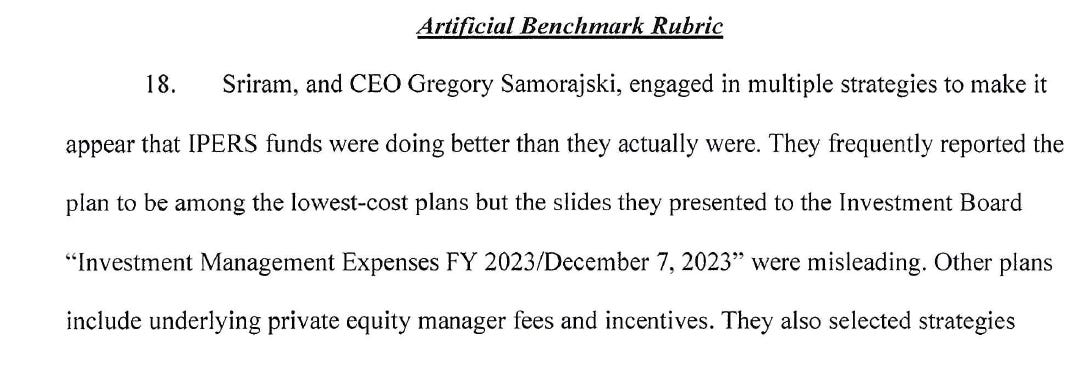

While IPERS’s returns look fine compared to the other plans in PPD… I have no idea how well they’re actually performing. Some of the funds are giving the results net of investment fees, and some are giving gross results (before fees are taken out). How are we to know?
That is one of the big issues in public pension investments, as the various funds have been racing after yield, so they do not have to drop their assumed rates of return and valuation rates for their liabilities… they’ve had incentives to pursue alternative (and leveraged) strategies, which invariably come with high costs… not to mention high risk.
This is not just an IPERS issue.
Where Does IPERS Land Re: Allocations to Alternatives?
My last update on allocations to alts among public plans:
Alternative Assets in Public Pensions: December 2025 Update

My recent post, in which alternatives (basically, everything outside publicly-traded securities and cash) featured, reminded me I hadn’t updated my ranking tables and stats:
Iowa PERS is smack dab in the middle of the ranking table, at #89 out of the 253 state and local plans I was able to get data for.
It does have a little elevated allocation to alternatives, compared to the median allocation — for FY 2024, it’s about 30%. For IPERS, it was 34%.
I don’t think that 4 percentage points makes a huge difference.
A LARGE NUMBER of public pensions are pursuing returns via alternative assets!
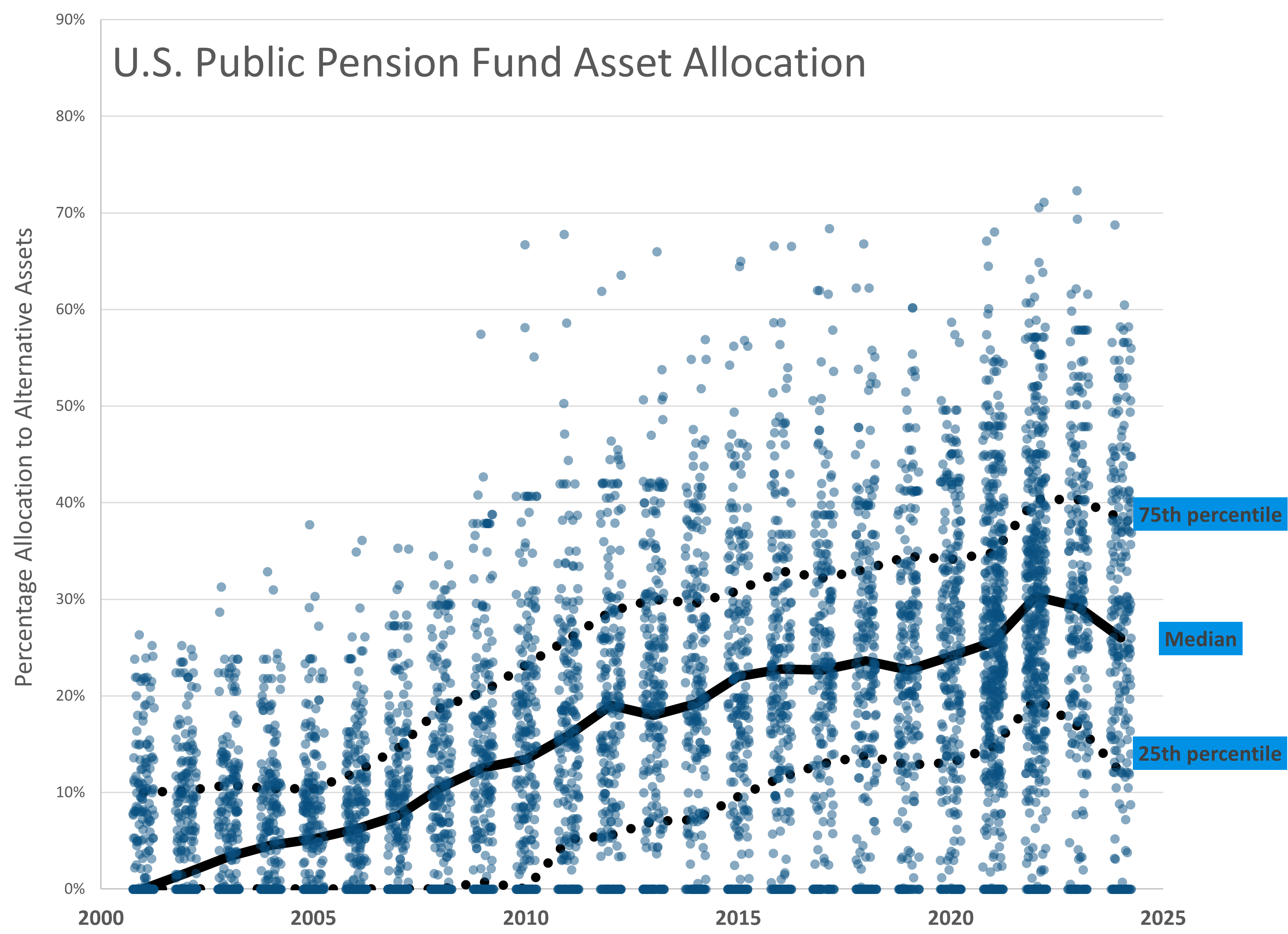
I am a bit skeptical re: the percentiles on FY 2024 and 2025 — we know how long it takes to get the information from government systems. For all we know, the allocations have continued to rise.
Governance of Public Pensions: All Over the Place
But the ultimate issue extends beyond just PSERS and IPERS.
There is more to the alleged fact pattern in Rich Wiggins’s amended petition, such as the person whom he (Wiggins) was supposed to provide some oversight as a risk officer was the person who had the power to fire him (uhhhhh….)
Wiggins claims that the benchmarks being used for performance incentives are nothing more than the actual fund strategies — basically a glorified tracking error, if that. But that he can’t really check, because the CIO’s formulas were never shared with them.
And I’m just clipping this bit:
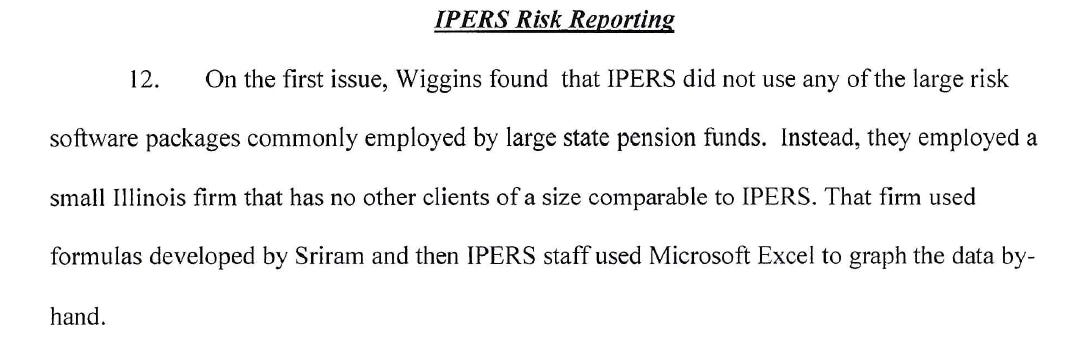
There are operational and governance issues with IPERS itself being asserted in this complaint.
But there are governance issues with public pensions that private pensions don’t have: namely, private pensions have regulatory oversight that public pensions don’t have at all. There is no ERISA for public employee benefits.
If there is a sole fiduciary (appointed by the governor? elected?) as opposed to a board of trustees… well, hope for a benevolent person in that role. They could wreak a lot of havoc.
Even when the professional staff working on the pension, and the sole fiduciary or board of trustees, do what they should do as fiduciaries… there is something else that can screw up the plan: the state legislature.
If the state legislature wants to mess around with the public pension assets, it can really screw it up. They’re not fiduciaries at all! There is pretty much nothing that can stop them from doing some really destructive stuff!
Should some nasty facts spill out of the IPERS lawsuit, I’m sure the usual people will point at the key people involved (after all, they’ve already been fired/resigned!)… but I wonder, will anybody notice that many of the same problems may infest multiple pension plans?
Does the 'alternative investment' category include crypto-related firms in addition to private capital?