

My recent post, in which alternatives (basically, everything outside publicly-traded securities and cash) featured, reminded me I hadn’t updated my ranking tables and stats:
Public Pension Asset Shenanigans: New York City on ESG Issues, Maryland Audit on Fees, and CalPERS on Total Portfolio Approach

The holiday season is busy busy busy… (and just had my water heater go, but that’s not for right now).
There is no particular timing for me to update these stats, so I may as well now.
Let’s get to it!
Public Plans Allocation to Alternative Assets
Links to older posts on this subject, as well as a spreadsheet with the current stats, will be at the bottom of this post.
For simplicity, what is not considered alternative assets:
publicly-traded equities
publicly-traded bonds and similar fixed-income securities
cash
That’s it for “core”, traditional investments.
My data comes from the Public Plans Database, and I grabbed it today.
The types of assets considered “alternative”:
private equity
real estate
hedge funds
commodities
assorted alternatives/other
So let’s see how it shakes out:
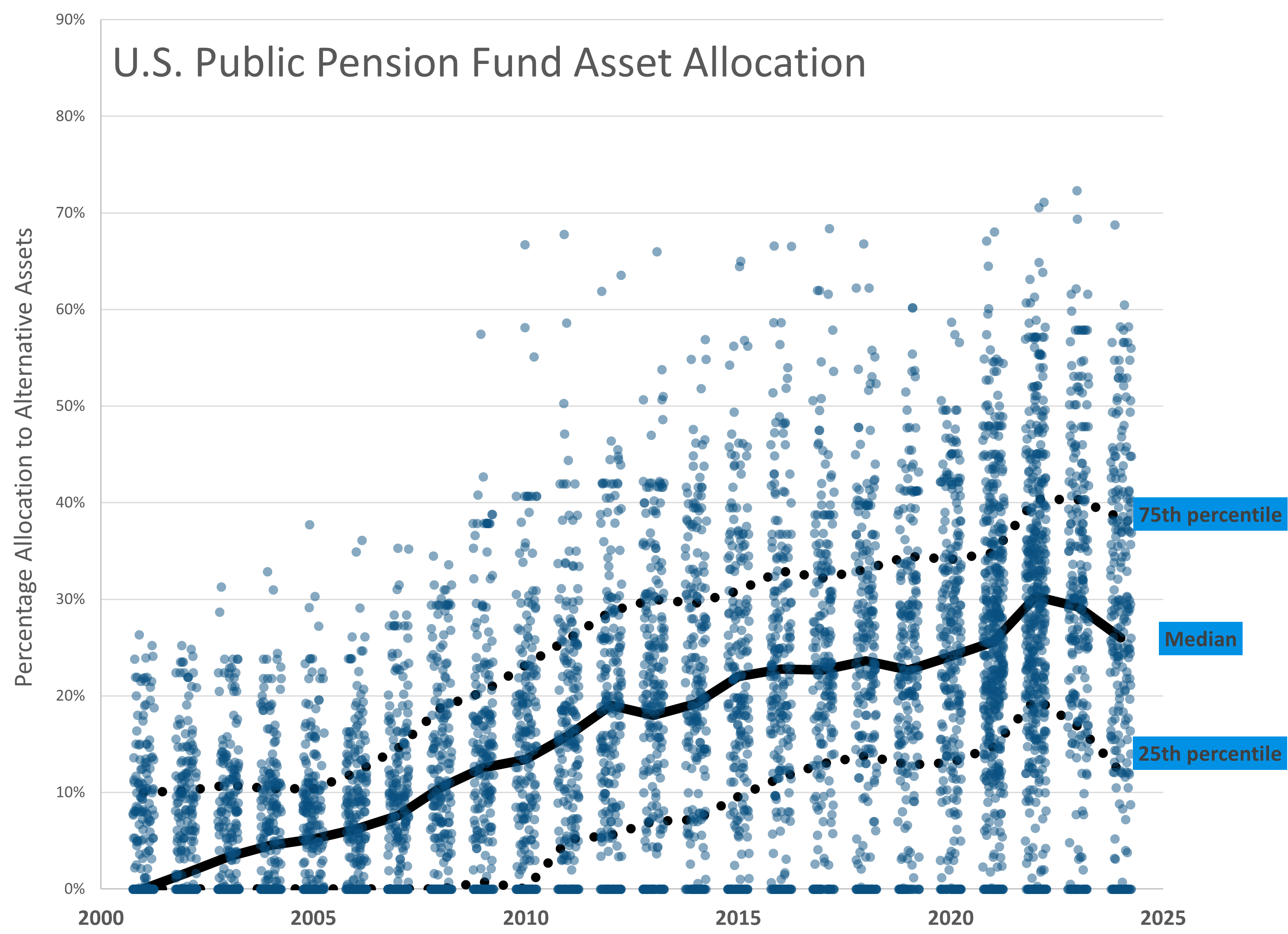
Observations:
There is a non-trivial number of plans that allocate 0% to alternative asset classes — up til 2010, at least 25% (though fewer than 50%) of the funds by count had allocations to alternatives.
However, the bulk of the allocations has been rising. It has been steadily increasing for the 25th percentile, median, and 75th percentile.
There appears to have been a drawing back from alts since FY2022; however, this may be an artifact of missing data for FY2024 (as shown below), as well as economic conditions, which I mentioned in January 2024.
The median allocation maxed out around 30% in 2022.
Public pension plans with the highest allocations to alternative assets
In just looking at the plans with the highest allocations to alternative assets, one gets a few odd patterns:
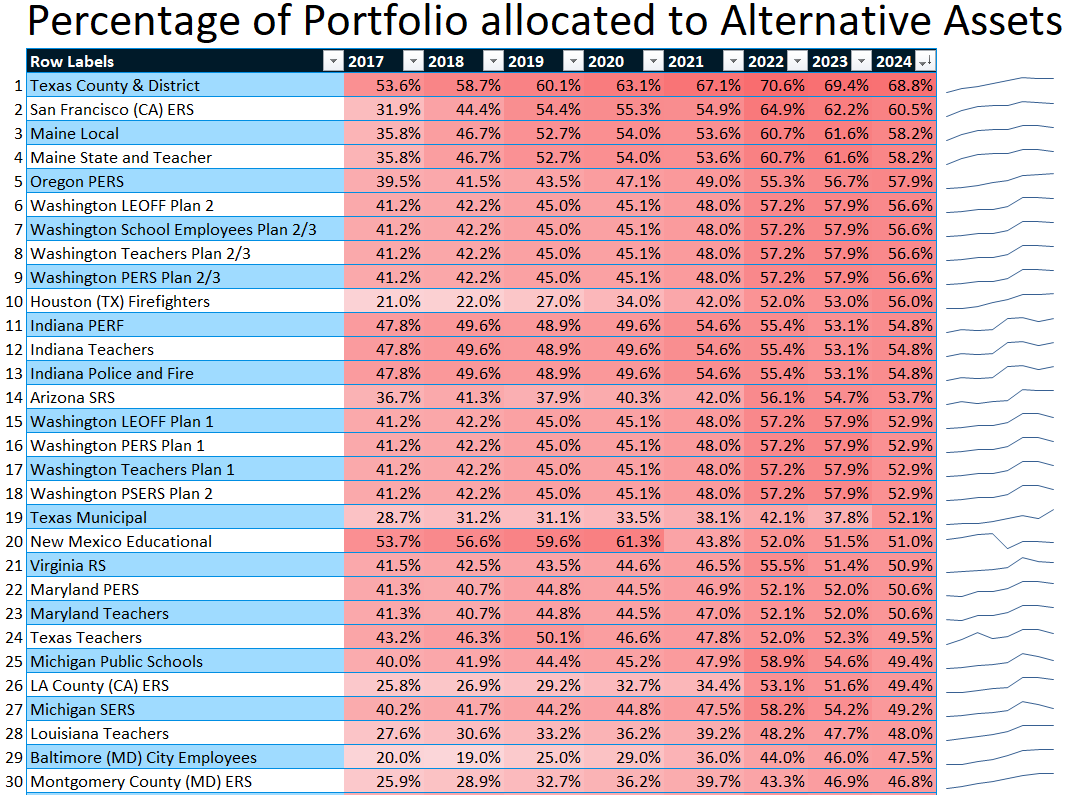
Several plans have large allocation jumps between 2021 and 2022. I explained that in the January 2024 post: the value of the “core” investments was down at FY2022 valuations. Allocations have to add to 100%, so, there you go.
Another issue with the ranking tables: shared asset management between pension funds. The reason the Maine Local fund and the Maine State and Teacher fund have the same allocations is that they have pooled assets. The same for the four Washington State plans and the three Indiana plans that are high on the list. This is rather common among public pension funds.
Some of these plans are relative newcomers to the alts game, but most have had relatively high allocations for a while.
Data Issues
But if you scroll down the ranking table, you can see obvious indications of missing data:

Those are probably missing data years, or just missing data elements.
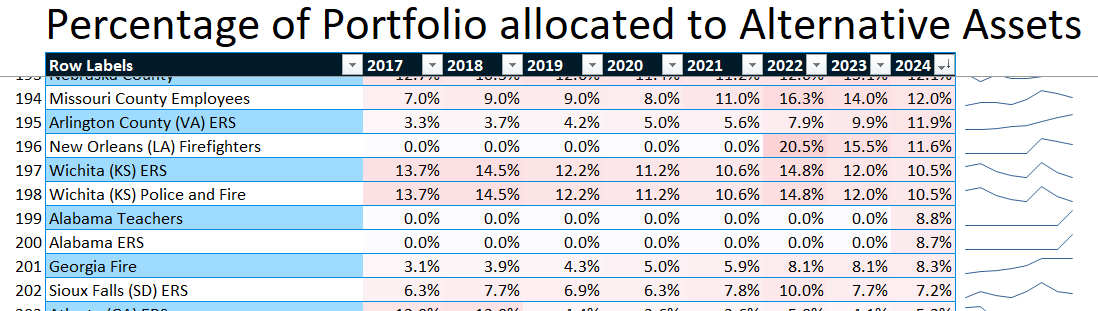
For some plans, like New Orleans (LA) Firefighters, these are relatively new plans to the database, so they prioritize entering more recent years of financials. Those older zeroes are likely not real.
I know for a fact that the Alabama Teachers/ERS plans have been in the database for a long time, and those zeroes are real… they have only just begun to add alternatives to their investments.
But the most common data issue looks like this:
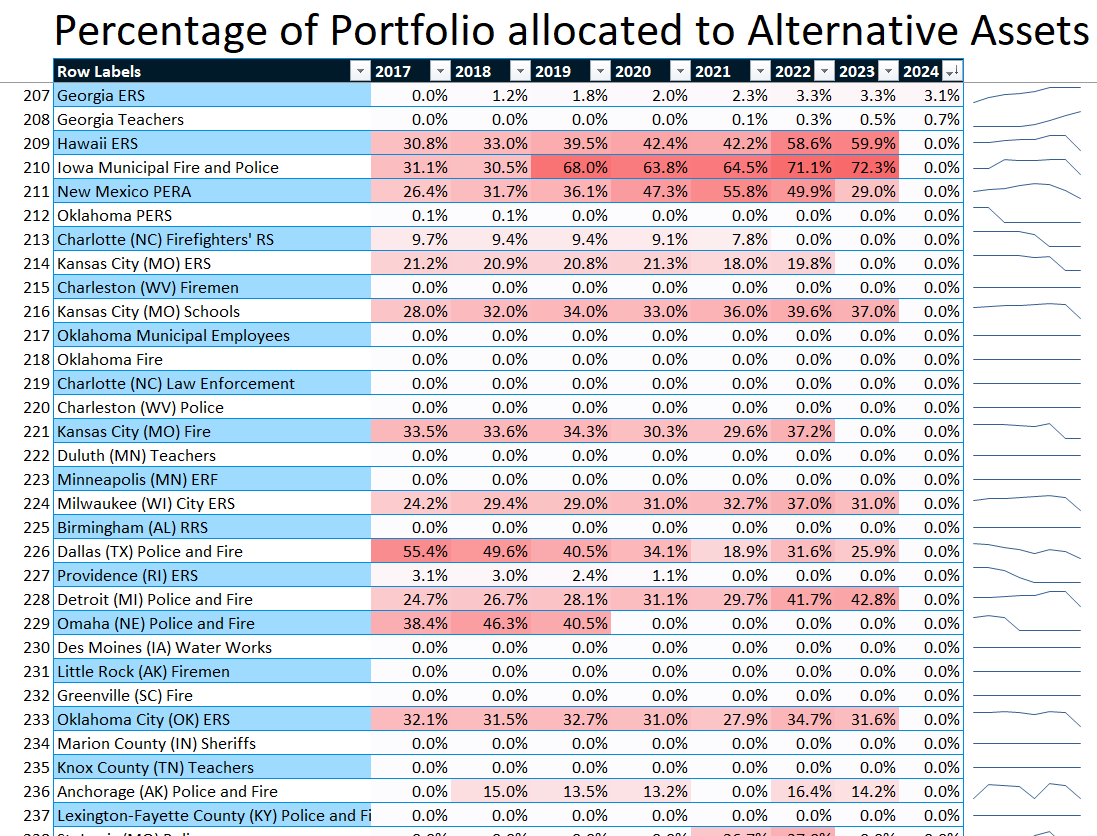
They simply did not have the FY2024 data yet for several plans. Those are also not real zeroes. A few plans are also missing 2023 data, but there are not as many of those.
There does seem to be a real decrease in allocations to alternatives in FY2023, but again, some of that is related to changing economic conditions.
Spreadsheet

Public Pensions in Alternative Assets Posts
A selection (not all of my alts posts)
Jan 2024: Alternative Assets in Public Pensions: January 2024 Update
May 2023: Choices Have Consequences: Public Pension Investments in Alternative Assets
May 2021: Which Public Pension Funds Have the Highest Holdings of Alternative Assets? 2021 Edition
2018: Alternative Assets and Pension Performance: A Dive into Data
2017: Which Public Pension Funds Have the Highest Holdings of Alternative Assets? Has It Paid Off?
2014: Public Pensions Watch: Don’t Go Chasing Waterfalls….or Alternative Asset Classes, pt 1 of many
August 2014: Public Pensions Watch: Dallas Pension Learns About Concentration Risk
September 2014: Public Pensions and Alternative Assets: Dallas Shows How It Can End
2017: Public Pension Assets: Our Funds were in Alternatives, and All We Got Were These Lousy High Fees
2015: Reddit-Public Pension Connection: Alternative Assets and Risk
2014: Public Pensions Watch: More Reactions to Calpers Pulling Out of Hedge Funds
2014: Public Pensions Watch: Alternative Assets, pt 8 of many — New Jersey followup